

Printed Circuit Boards (PCBs) and Printed Circuit Board Assemblies (PCBAs) form the technological backbone of virtually every electronic device in use today—from the smartphone in your pocket to the medical equipment in hospitals, from automotive control systems to aerospace navigation instruments. Yet many people, including those working in electronics, use these terms interchangeably without fully understanding the critical distinction between them.
This comprehensive guide explains the differences between PCBs and PCBAs, their manufacturing processes, cost implications, and when to choose one over the other. Whether you are an engineer evaluating production options, a procurement manager sourcing components, or a newcomer to electronics manufacturing, this information will help you make informed decisions that directly impact your product’s quality, timeline, and cost.
What is a PCB?
A Printed Circuit Board is a bare substrate board made from insulating material—most commonly fiberglass-reinforced epoxy resin (FR-4)—with conductive copper traces etched onto its surface. These traces form the electrical pathways that will eventually connect electronic components. Think of a PCB as a carefully designed foundation: it provides both mechanical support and the electrical infrastructure needed for components to communicate and function.
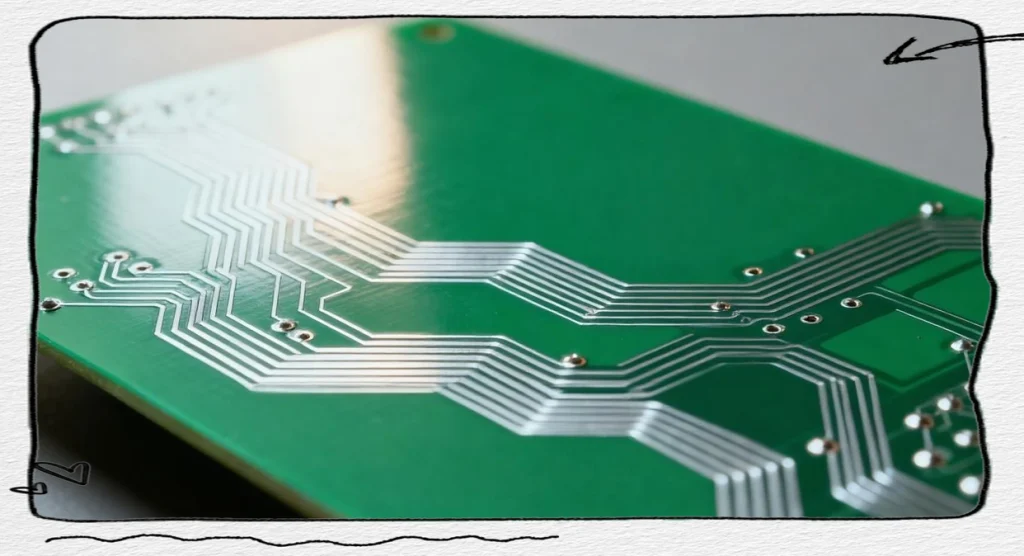
The Core Structure of a PCB
Every PCB consists of several essential layers that work together:
The Substrate Layer serves as the physical foundation, typically 1.6mm thick for standard applications. FR-4 is the industry standard because it offers excellent mechanical strength, electrical insulation, and cost efficiency. For specialized applications requiring high flexibility, manufacturers use polyimide film substrates. For extremely high-frequency applications above 10GHz, materials like Rogers or other ceramic-filled composites provide superior dielectric properties.
Copper Layers are laminated onto the substrate during manufacturing. A single-sided PCB has copper on one side; double-sided PCBs have copper on both sides; multilayer boards contain multiple copper layers separated by insulating material. The thickness of copper is measured in ounces per square foot—typically 1oz or 2oz for standard boards, though some high-current applications use up to 4oz or 5oz copper.
The Solder Mask is a protective polymer layer applied over the copper traces. Traditionally green, it now comes in multiple colors (red, blue, white, black) for different aesthetic or functional purposes. This mask prevents solder bridges between adjacent traces during assembly and protects copper from oxidation during storage.
The Silkscreen Layer is printed on top of the solder mask, containing reference designators, part numbers, polarity markers, and test points. This layer guides assembly technicians and provides critical information for troubleshooting and maintenance.
Vias and Through-Holes are drilled into the PCB to connect different layers electrically or to allow component leads to pass through. Plated Through-Holes (PTHs) have copper plating inside them, making them conductive; blind vias connect only outer layers to inner layers; buried vias are completely internal.

PCB Types and Their Applications
Single-layer PCBs contain one conductive layer and are the simplest form. Applications include basic LED driver circuits, simple power supplies, educational projects, and consumer devices like calculators. Their cost advantage makes them suitable for high-volume, low-complexity products. However, they limit circuit density significantly.
Double-layer PCBs expand design possibilities by providing copper on both sides connected through vias. This allows for more complex signal routing, better ground plane distribution, and improved electromagnetic compatibility. They are widely used in automotive electronics, industrial control systems, power supplies, and consumer appliances. The additional manufacturing complexity increases cost modestly but dramatically improves functional capabilities.
Multilayer PCBs contain four or more copper layers, enabling extremely dense component placement and complex signal routing. Four-layer boards are the most common multilayer variant, with two signal layers and dedicated ground and power planes. Six, eight, and even ten-layer boards are standard in computing, telecommunications, and advanced medical devices. Some aerospace and defense applications use 20+ layers. As layer count increases, manufacturing complexity and cost rise significantly, but electrical performance, density, and reliability improve substantially.
Flexible PCBs use polyimide film instead of FR-4, allowing the board to bend or flex repeatedly without cracking. These enable form factors impossible with rigid boards—like wearable devices, rollable displays, and camera modules. Flex-rigid combinations offer both rigid sections for component mounting and flexible sections for interconnection.
| PCB Type | Features | Applications |
|---|---|---|
| Single-Layer | One copper layer, simple design | Simple devices like calculators, LED boards |
| Double-Layer | Copper on both sides, flexible routing | Commercial electronics, basic consumer devices |
| Multilayer | Multiple stacked layers with insulation | Smartphones, medical devices, aerospace systems |
| Flexible PCB | Bendable polyimide material | Wearables, cameras, compact devices |
| Rigid-Flex PCB | Combination of rigid and flexible sections | Medical devices, military systems, advanced smartphones |
| High-Frequency PCB | Specialized materials for frequencies >1GHz | Medical devices, military systems, and advanced smartphones |
Key Design Parameters That Affect PCB Performance
Trace Width and Spacing determine current-carrying capacity and noise immunity. Fine-pitch designs (0.1mm spacing) enable higher component density but require more advanced manufacturing capabilities. Standard designs use wider traces (0.2mm+) for easier manufacturing and better yield.
Impedance Control becomes critical in high-speed digital circuits and RF applications. PCBs for these applications require carefully controlled trace geometry, layer stack-up, and dielectric properties to maintain specific impedance values—often 50 ohms for RF work or 85 ohms for differential signaling in high-speed digital systems.
Thermal Management features like copper pours, thermal vias, and thicker copper layers help dissipate heat from power components. In modern designs with high-power processors or switching regulators, thermal design often determines product reliability more than electrical performance alone.
What is PCBA?
A Printed Circuit Board Assembly represents the next evolutionary step—a PCB populated with all necessary electronic components, soldered in place, tested, and ready for integration into end products. Where a PCB is non-functional on its own, a PCBA is a complete working module.

Components in a PCBA
PCBAs incorporate various electronic components, each serving specific functions:
Passive Components like resistors, capacitors, and inductors represent the majority of components by count. Resistors control current flow and voltage division; capacitors filter power supplies and couple signals between stages; inductors manage current changes and filter noise. Modern passive components measure as small as 0402 (1mm x 0.5mm), requiring highly precise automated assembly.
Active Components include transistors, integrated circuits (ICs), and diodes. These components amplify signals, perform logical operations, and control power distribution. Modern processors contain billions of transistors in a single package. Ball Grid Array (BGA) packages with 1000+ connection points present assembly challenges requiring X-ray inspection to verify solder joint quality inside the package.
Connectors and Interfaces enable communication between the PCB and external devices or other PCBAs. USB connectors, audio jacks, RF connectors, and specialized industrial connectors must be reliably soldered to withstand mechanical stress and environmental exposure.
Power Components like voltage regulators and power diodes handle relatively large currents and dissipate significant heat. These components demand careful thermal design and robust solder connections to ensure long-term reliability.
Assembly Technologies: How Components Get Connected
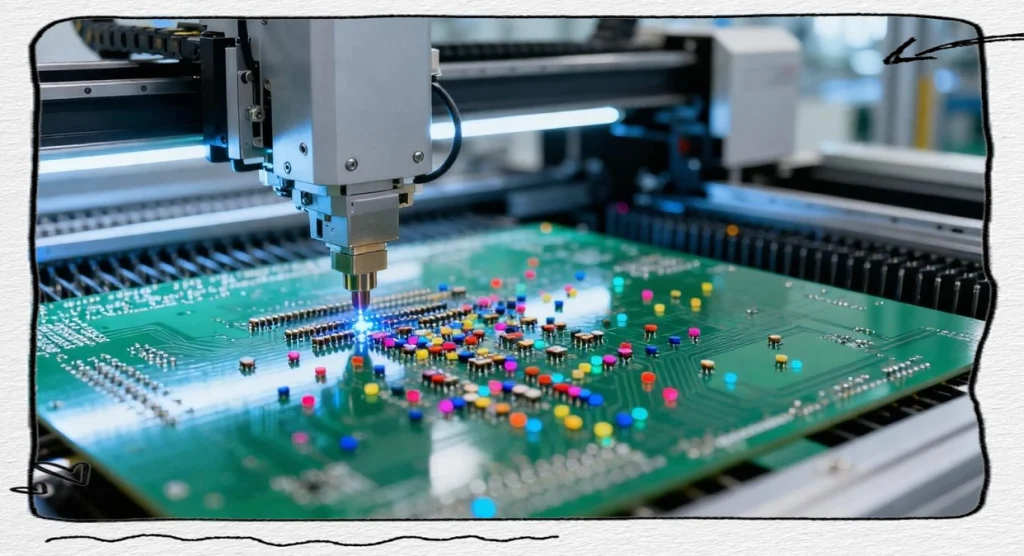
Surface Mount Technology (SMT) dominates modern electronics manufacturing. Components with tiny leads are placed directly on the PCB surface by high-speed pick-and-place machines, achieving placement accuracy of ±0.1mm at rates exceeding 100,000 placements per hour. Solder paste (a mixture of tiny solder particles suspended in flux) is applied through a stencil, components are placed, and the entire assembly passes through a reflow oven. The temperature profile carefully rises to around 250°C, melting the solder paste and creating permanent connections.
SMT enables extremely high component density—a single 300mm x 300mm board might hold 10,000+ components on both sides. Modern consumer electronics, IoT devices, and high-performance computing all rely entirely on SMT. The process is highly automated, making unit costs attractive at volumes above 5,000 units.
Through-Hole Technology (THT) represents the traditional assembly method where component leads pass through drilled holes and are soldered on the opposite side. THT creates exceptionally robust connections, making it preferred for components subject to mechanical stress or requiring high current capacity. Large connectors, electrolytic capacitors, and power components often use THT despite requiring more assembly time.
Mixed Assembly combines both technologies on the same board. Large through-hole components provide mechanical strength and reliability; SMT components provide density and electrical performance. This hybrid approach is common in industrial electronics, consumer products requiring durability, and specialized applications.

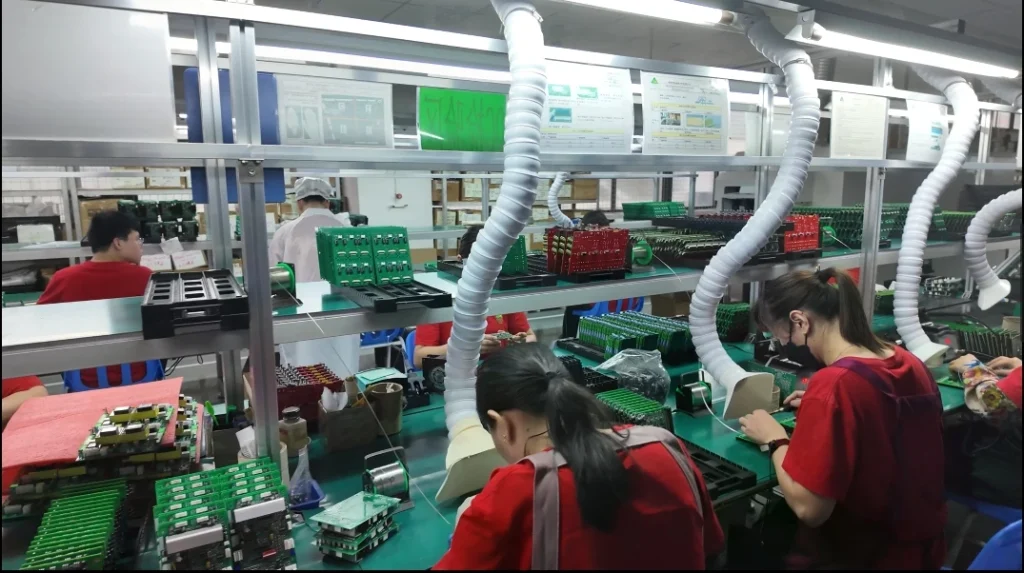
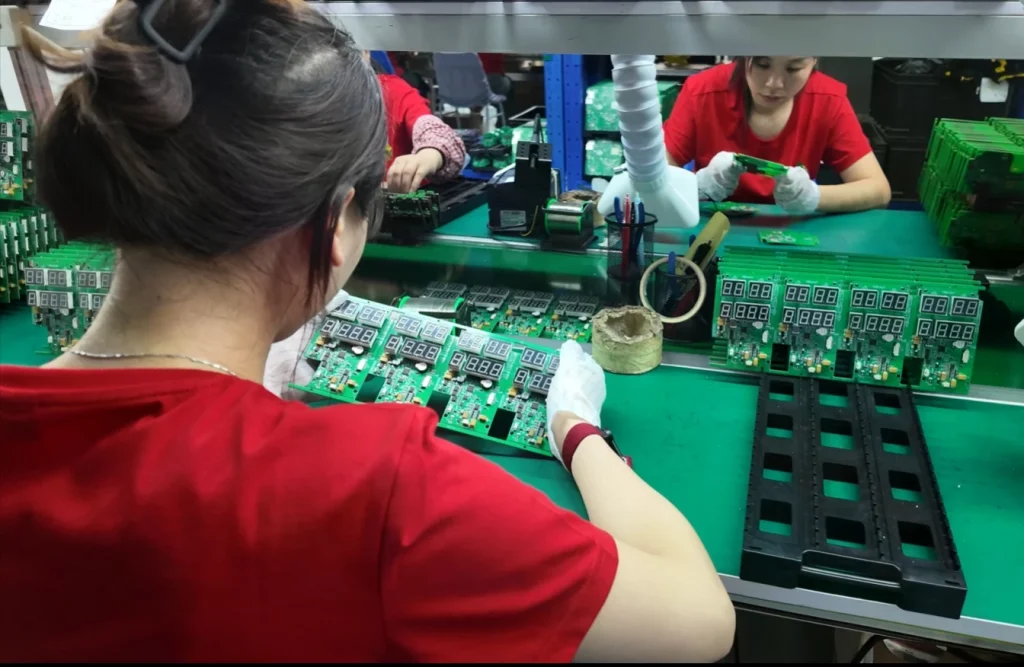
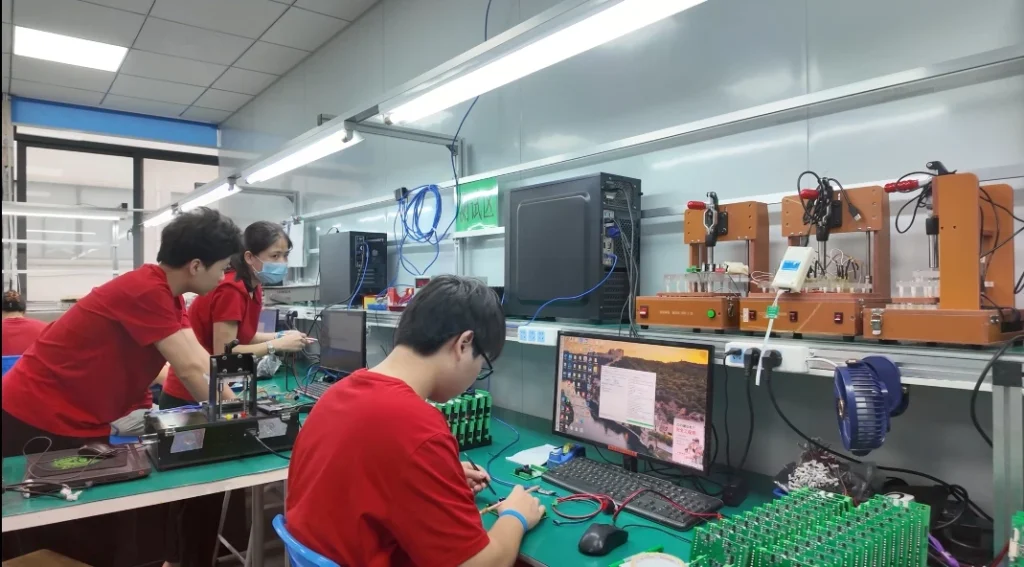
PCBA Quality Testing and Inspection
Modern PCBAs undergo multiple rigorous testing stages to ensure reliability:
Automated Optical Inspection (AOI) uses high-resolution cameras and sophisticated image analysis to detect component placement errors, missing components, solder bridges, and insufficient solder coverage. AOI systems inspect 100% of assemblies, catching defects before they cause problems.
Solder Joint Inspection via X-ray becomes necessary for BGA and other hidden-connection packages where solder joints cannot be visually assessed. X-ray systems reveal solder voids, insufficient solder, cold joints, and interconnection problems that visual inspection cannot detect.
In-Circuit Testing (ICT) applies test patterns to the assembled board’s test points, verifying electrical connectivity and basic component functionality. ICT catches approximately 70% of potential defects through electrical measurement at specific node points.
Functional Testing powers up the assembly and exercises all circuits under realistic operating conditions. Functional tests verify processor operation, memory functionality, signal processing, and output control. Products with analog circuits, audio, video, or wireless capabilities require functional testing to ensure full operation.
Burn-in Testing runs the assembly at elevated temperature for extended periods—often 48-168 hours—to identify latent defects. Components often fail shortly after manufacturing due to manufacturing-induced stresses; burn-in eliminates these early failures before the product reaches customers.
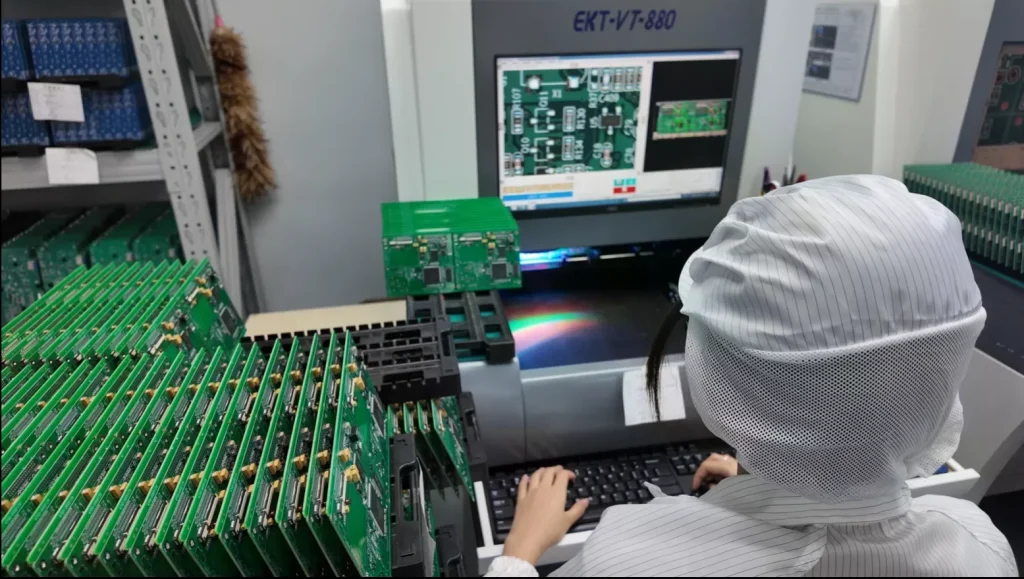

The Technical Differences Between PCB and PCBA
The distinction between PCB and PCBA extends far beyond simply adding components. Several critical differences affect manufacturing, cost, timeline, and functional capability.
| Aspect | PCB (Bare Board) | PCBA (Assembled Board) |
|---|---|---|
| Definition | Substrate with copper only | PCB with all electronic components |
| Functionality | Non-functional | Fully functional electronic unit |
| Processes | Design, etching, drilling | SMT, placement, soldering, testing |
| Cost | Lower | Higher (includes assembly, parts) |
| Components | None | Populated (ICs, resistors, etc.) |
| Usage | Foundation for assembly | Ready for product integration |

Functionality and Readiness
A bare PCB is incomplete and non-functional—it cannot perform any electronic operations whatsoever. Current cannot flow through it without external component connections. The PCB provides only the structural and conductive framework.
A PCBA, by contrast, is a complete functional module ready to perform its intended electronic operations. All necessary components are in place, tested, and operational. This difference determines your supply chain strategy: with PCBs, you manage multiple suppliers for boards and components separately; with PCBAs, a single manufacturer handles everything.
Manufacturing Process and Timeline
PCB manufacturing involves relatively straightforward steps: design, substrate preparation, copper lamination, etching, drilling, plating, coating, and packaging. The entire process typically takes 2-4 weeks, depending on complexity and volume.
PCBA manufacturing adds significant complexity: component procurement and verification, stencil creation, solder paste application, pick-and-place machine programming, reflow profile optimization, inspection calibration, test point configuration, and functional test script development. A complete PCBA typically requires 4-8 weeks from order confirmation to shipment, with much of this time spent on component sourcing and test setup rather than actual manufacturing.
Cost Structure
PCB costs derive from four factors: substrate material and thickness, layer count, trace width/spacing (design complexity), and special finishes. A typical PCB costs between $0.50 and $50 per unit, depending on these variables.
PCBA costs include PCB base cost plus four additional elements: component costs (often 40-60% of total), assembly labor and processing (20-30%), quality assurance and testing (10-15%), and supplier overhead and margin (10-20%). Component costs vary dramatically based on component selection—a simple board might cost $3-5 per unit, while a complex board with advanced processors, memory, and RF components might cost $100-500+ per unit.
Supply Chain Complexity
A PCB order requires only design files and board specifications. Supply chain complexity is minimal.
A PCBA order requires component sourcing expertise, Bill of Materials (BOM) management, component verification to prevent counterfeits, delivery coordination to match production schedules, and inventory management. Component availability fluctuates significantly—as of 2025, shortages in specific component categories still affect lead times and pricing. Managing this complexity independently requires substantial infrastructure.
Quality Control Requirements
PCBs require substrate-level testing: electrical continuity checks, resistance measurements, and visual inspection for manufacturing defects. Quality standards are relatively straightforward—ISO standards for substrate manufacturing ensure consistency.
PCBAs require comprehensive quality protocols: visual inspection, electrical testing, functional testing, and environmental stress testing. IPC-A-610 electronics assembly standards define acceptable workmanship; IPC-J-STD-001 specifies soldering requirements; ISO 9001 quality management systems ensure process consistency. This complexity justifies higher PCBA costs.
Lead Time Variability
PCB lead times are relatively predictable. Once the design is finalized, the fabrication duration is consistent based on board complexity.
PCBA lead times vary significantly based on component availability. If a single component in a 500-component BOM is unavailable or backordered, the entire assembly is delayed. For this reason, experienced PCBA manufacturers maintain a strategic buffer stock of critical components and employ supply chain optimization techniques.
Deciding Between PCB and PCBA – A Practical Framework
The choice between bare PCBs and complete PCBAs depends on your specific situation, capabilities, and priorities. Understanding the decision factors helps you optimize cost, timeline, and risk.
When to Choose Bare PCBs?
- Established Manufacturing Capability: If your organization maintains dedicated PCB assembly equipment, skilled assembly technicians, and quality control infrastructure, bare PCBs provide cost advantages through component procurement discounts and elimination of manufacturer markups.
- Component Sourcing Expertise: Companies with long-established supplier relationships, strong negotiating power, and components procurement expertise can often source components more economically than PCBA manufacturers charge. Large organizations frequently benefit from this approach.
- Design Flexibility and Iteration: During development phases when designs change frequently, bare PCBs allow you to modify component selections without locked-in manufacturing costs. This flexibility accelerates innovation and enables rapid pivots based on testing feedback.
- Proprietary Component Integration: In cases where you require specialized components, custom part selections, or integration of proprietary subsystems, bare PCBs provide the control necessary for unique implementations.
- Supply Chain Independence: Some manufacturers prefer controlling the entire supply chain to ensure supply security, negotiate directly with component suppliers, and manage inventory according to strategic preferences.
- Cost Examples at Scale: At 10,000 monthly units, an organization with assembly capability might achieve $15 per unit board plus $80 in components plus $5 assembly labor, totaling $100 per unit. A PCBA manufacturer might charge $130 for the identical board, reflecting component sourcing markup and overhead.
When to Choose PCBAs?
- Speed and Time-to-Market: PCBA manufacturers optimize production processes and maintain component inventory, often delivering faster than managing separate component sourcing and assembly. For products where first-mover advantage matters, PCBA services reduce time-to-market by weeks.
- Reduced Capital Expenditure: Assembly equipment (pick-and-place machines, reflow ovens, test equipment) represents substantial capital investment—often $500,000 to several million dollars. PCBA outsourcing eliminates this requirement, freeing capital for R&D, marketing, and sales.
- Quality Assurance and Certifications: Established PCBA manufacturers maintain ISO 9001, IPC-A-610, and industry-specific certifications (medical, aerospace, automotive). Building an equivalent certification infrastructure internally requires years of effort and continuous audit costs.
- Flexible Volume Scaling: PCBA manufacturers accommodate volume swings efficiently—scaling production from 100 units to 100,000 units monthly without requiring capital equipment changes. Companies scaling rapidly benefit from this flexibility.
- Reduced Operational Complexity: Managing component procurement, supplier relationships, quality compliance, and test development adds organizational complexity. PCBA manufacturers handle this, allowing your team to focus on core competencies.
- Lower Risk for Startups and New Products: New product launches carry inherent risk. Using established PCBA manufacturers shifts quality and schedule risk to experienced partners, improving success probability.
- Cost Example at Startup Scale: At 1,000 monthly units, internal assembly costs might exceed $150 per unit due to setup and overhead spread across small volumes. A PCBA manufacturer might offer the same product at $125 per unit through volume purchasing and optimized processes.
Decision Matrix for PCB vs PCBA
Your decision should consider multiple factors weighted by importance for your situation:
- In-House Assembly Capability (Quality and equipment): Choose PCB if you have proven assembly capability; choose PCBA if lacking.
- Volume and Scalability (Current and projected): Established high-volume operations might choose PCB for cost optimization; variable or growing volumes favor PCBA flexibility.
- Quality Certifications (Industry requirements): If your market requires AS9100 (aerospace), IATF 16949 (automotive), or medical device certifications, PCBA manufacturers with these certifications reduce your burden.
- Time-to-Market Pressure (Development timeline): Rapid time-to-market requirements favor PCBA; planned, measured launches can accommodate PCB sourcing and internal assembly.
- Component Sourcing (Expertise and relationships): Established component sourcing relationships and expertise favor PCB; limited sourcing experience favors PCBA.
- Capital Budget (Upfront vs Ongoing Costs): Constrained initial capital favors PCBA; available capital for equipment investment might support PCB economics over time.
- Supply Chain Sophistication (Organizational maturity): Advanced supply chain operations can leverage PCB economics; developing supply chain capabilities benefits from PCBA simplicity.
| Factor | Choose PCB | Choose PCBA | Notes |
|---|---|---|---|
| In-house assembly | Yes | No | PCB for equipped factories |
| Volume | Large, stable | Variable, growing | PCBA for fast scaling |
| Certifications | In-house | Supplier provided | PCBA for regulatory compliance |
| Component sourcing | Sophisticated | Limited | PCBA minimizes sourcing complexity |
| Capital budget | Available | Constrained | PCBA needs less up-front investment |
| Supply chain | Mature | New/developing | PCBA for easier supply management |
Cost Analysis for Mass Production
Understanding cost structures enables accurate financial planning and informed supplier selection.
PCB Cost Components
Substrate Material Cost: Base FR-4 material for a standard 300mm x 300mm board costs approximately $2-5, depending on thickness and material grade.
Processing Labor: Design-to-fabrication labor, including CAM preparation, tooling, and manufacturing setup, typically adds $3-8 per board.
Copper Layer Preparation: Lamination and etching of copper layers costs $2-4 per board for double-sided boards; multilayer boards add $5-20+ per additional layer due to complexity and yield losses.
Drilling and Via Plating: Precision drilling and electroplated via plating add $3-8 per board ,depending on hole count and via density.
Finishing and Quality Control: Solder mask coating, silkscreen printing, finishing treatments, testing, and inspection add $2-5 per board.
Volume Discounts: At increasing volumes, per-unit costs decline significantly:
- 10 units: $20-30 per unit
- 100 units: $8-15 per unit
- 1,000 units: $3-8 per unit
- 10,000 units: $1.50-4 per unit
PCBA Cost Components
Component Costs: Vary dramatically based on design. A simple board might total $10 in component cost; a complex board might total $200+. Component costs represent the single largest variable in PCBA pricing.
Component Procurement Markup: PCBA manufacturers add 10-25% to component costs for procurement overhead, supply chain risk, and buffer stock maintenance.
Assembly Labor: Varies by technology. SMT assembly averages $0.02-0.08 per component, depending on component density and complexity. A 500-component board costs $10-40 in assembly labor. Through-hole assembly costs $1-3 per component due to manual involvement.
Solder and Flux Materials: Solder paste, cleaning materials, and flux cost approximately $0.50-2 per board, depending on component density.
Equipment and Overhead: Factory overhead, equipment depreciation, facility costs, and administrative expenses add $5-15 per board, depending on manufacturing scale and efficiency.
Quality Testing: AOI, ICT, functional testing, and burn-in testing add $2-8 per board, depending on test coverage. Complex products with extensive functional testing can exceed $15 per board in testing costs alone.
Packaging and Logistics: Anti-static packaging, labeling, and shipping add $2-5 per board.
Real-World Pricing Examples
Simple LED Driver Board (50 components, SMT):
- Components: $4
- Manufacturing: $3
- Testing: $1
- Total PCBA cost: $8 per unit at 10,000 volume
- Bare PCB cost: $1.50 per unit
- Internal assembly cost (your labor): $2 per unit
- Total internal cost: $7.50 per unit
Mid-Complexity IoT Device (200 components, SMT + THT):
- Components: $25
- Manufacturing: $8
- Testing: $3
- Total PCBA cost: $36 per unit at 5,000 volume
- Bare PCB cost: $4 per unit
- Internal assembly cost: $5 per unit
- Total internal cost: $34 per unit (but requires assembly infrastructure)
High-Complexity Industrial Controller (800 components, multilayer PCB, BGA packages):
- Components: $120
- Manufacturing: $15
- Testing: $8
- Total PCBA cost: $143 per unit at 2,000 volume
- Bare PCB cost: $20 per unit
- Internal assembly cost: $15 per unit
- Testing infrastructure cost: $25-40 per unit (amortized equipment and setup)
- Total internal cost: $175-190 per unit if attempting internally
At scale above 5,000 units monthly, PCBA manufacturer efficiency typically matches or beats internal assembly for most product categories. The combination of component bulk purchasing power, manufacturing automation, and test efficiency creates economies of scale that are difficult to replicate internally.
Turnkey PCBA vs Consignment Assembly – Service Models
Beyond the PCB vs PCBA decision, procurement teams must understand service delivery models that affect pricing, control, and responsibility.
| Factor | Turnkey PCBA | Consignment Assembly |
|---|---|---|
| Sourcing | Supplier manages | Customer manages |
| Cost | Higher | Lower per unit |
| Control | Moderate | Maximum |
| Risk | Supplier absorbs | Customer absorbs |
| Speed | Fast | Dependent on sourcing |
| Best For | Convenience, speed | Cost, custom sourcing |
Turnkey PCBA
Turnkey PCBA represents a complete end-to-end solution where the manufacturer assumes responsibility for every aspect. Your role is to provide design files and specifications; the manufacturer handles the remainder.
Included Services: Design for manufacturability (DFM) review, component sourcing and procurement, component verification and counterfeit prevention, PCB fabrication, assembly, testing, quality assurance, and delivery to your specified location.
Advantages: A Single point of accountability and responsibility makes problem resolution straightforward. Economies of scale through component bulk purchasing often result in better component pricing than you could negotiate independently. You eliminate supply chain complexity—no tracking multiple component suppliers, no managing inventory, no coordinating component delivery to the assembler. The manufacturer handles all complexity and risk. Lead times are often shorter because manufacturers maintain optimized component inventory and streamlined workflows. Flexible scaling accommodates volume changes from prototypes to mass production without requiring infrastructure changes.
Disadvantages: Higher per-unit cost reflects the manufacturer’s sourcing markup and overhead. You have limited control over component selection—manufacturers may substitute components for equivalent functionality or availability. Changing suppliers later requires re-qualification and design adjustments. Less pricing leverage if locked into a single supplier relationship.
Typical Turnkey Pricing: $130-160 per PCBA unit for moderate complexity boards at 10,000 monthly volume.
Consignment Assembly
Consignment assembly places component procurement responsibility entirely on you. You source components and deliver them to the manufacturer; they handle assembly, testing, and quality control only.
Service Scope: Manufacturer receives your pre-selected components and PCBs, performs assembly, executes testing protocols you specify, and returns finished PCBAs. Your organization maintains complete component procurement responsibility.
Advantages: Significant cost savings through elimination of manufacturer markup on components—typically 10-20% reduction compared to turnkey. You maintain complete control over component selection, allowing optimization for cost, performance, or supply chain resilience. Direct supplier relationships enable negotiating volume discounts and priority allocation during shortages. Lower per-unit assembly costs since the manufacturer has fewer overhead responsibilities.
Disadvantages: Substantial operational complexity—you must develop and manage supplier relationships, verify component authenticity to prevent counterfeits, coordinate delivery timing to match production schedules, and maintain component inventory. Much longer lead times since you must source components first; manufacturing cannot begin until all components are in hand. If a single component becomes unavailable, your entire order is delayed. You assume all supply chain risk and responsibility for component quality. Requires skilled procurement personnel and supply chain infrastructure.
Typical Consignment Pricing: $80-100 per assembly unit at 10,000 monthly volume (excludes components), compared to $130-160 for turnkey.
Real-World Application Scenarios
Different industries and product categories employ distinct strategies tailored to their unique requirements.
Consumer Electronics: High-volume smartphone and tablet manufacturers use primarily PCB sourcing combined with internal assembly at scale, or PCBA turnkey for outsourced products. Speed-to-market and consistent quality at massive volumes drive decisions.
IoT and Connected Devices: Startup IoT companies typically use turnkey PCBA to accelerate time-to-market and minimize capital investment. Established IoT manufacturers scale to consignment assembly as volumes increase.
Medical Devices: Strict regulatory requirements and traceability demands make PCBA turnkey with certified manufacturers the standard. Regulatory complexity exceeds most companies’ expertise to manage independently.
Industrial Equipment: Industrial manufacturers often use bare PCBs for high-reliability through-hole assemblies where durability matters more than cost. Custom component selections for specific industrial requirements drive this choice.
Automotive: Large automotive manufacturers typically employ bare PCBs with internal assembly for high-volume commodity products, but use PCBA services for specialized or lower-volume modules. Safety and reliability requirements are paramount.
Aerospace and Defense: Highly specialized requirements, extensive testing, and regulatory compliance make PCBA services from certified manufacturers essential. The complexity and criticality exceed typical internal capabilities.
| Application | Volume | Preferred Model | Main Driver |
|---|---|---|---|
| Smartphones | 1M+/year | PCBA turnkey | Speed, quality |
| IoT Devices | 10k-100k/year | PCBA mixed | Flexibility, cost |
| Medical Devices | 1k-50k/year | PCBA turnkey | Compliance, quality |
| Industrial Controllers | 5k-50k/year | Flexible/PCBA | Reliability, support |
| Consumer Prototypes | <1k | Turnkey PCBA | Speed, simplicity |
Conclusion
The distinction between PCBs and PCBAs represents more than terminology—it defines your entire manufacturing strategy, supply chain complexity, capital requirements, and time-to-market capability. PCBs provide the foundation; PCBAs deliver complete functionality.
Your choice depends on organizational capabilities, product volume, market requirements, and strategic priorities. Startups and companies pursuing rapid growth typically benefit from PCBA turnkey services. Established manufacturers at a large scale often achieve economies through bare PCB sourcing combined with optimized internal assembly.
Neither choice is universally superior. The optimal decision balances your specific circumstances—whether you prioritize speed, cost, control, or risk mitigation. Understanding these distinctions and their implications enables strategic decisions that improve your product success and business performance.
For global manufacturers seeking reliable PCB and PCBA solutions, IWDF Solutions offers comprehensive services that span design, manufacturing, and assembly. Whether you require bare PCBs, turnkey PCBA services, or consignment assembly, our experienced team helps you navigate these decisions and execute your manufacturing strategy effectively. Contact us to discuss your specific requirements and discover how our solutions can support your business objectives.