
Touch Screen POS Terminal PCB Design & PCBA Case Study
Industry: Retail / Food & Beverage / Hospitality
Product Type: Android Touch Screen POS Terminal
Service Scope: PCB Design + PCBA Manufacturing + Engineering Support
Project Overview
Industry: Retail · Restaurant · Hospitality
Product Type: Android Touch Screen POS Terminal
Application Scenarios: Checkout · Mobile Ordering · Front Desk Payment · Inventory Query
Service Scope: PCB Design · Hardware Architecture · DFM Optimization · PCBA · Functional Validation
As digital payment and smart retail continue to evolve, POS terminals are no longer simple cash registers. Modern POS devices must handle multi-interface peripherals, wireless payments, real-time data synchronization, and continuous daily operation — all within a compact, cost-sensitive hardware platform.
For this project, the customer required an Android-based touch screen POS terminal supporting Wi-Fi 6, Bluetooth 5.2, NFC, optional cellular connectivity, and multiple external devices such as barcode scanners, thermal printers, and cash drawers. The PCB had to deliver stable performance, strong anti-interference capability, and long-term reliability, while remaining suitable for mass production and regional customization.
IWDF Solutions provided a one-stop PCB design and PCBA manufacturing solution, guiding the project from hardware architecture definition and layout to prototype validation and production-ready delivery.
PCB Design Challenges|What Made This POS Terminal Complex
Designing this Android POS terminal PCB required balancing multi-interface reliability, wireless stability, and long-hour commercial operation within a compact hardware platform.
High-Density Interface Integration
This POS terminal acts as a hub for scanners, printers, cash drawers, and Ethernet connections operating at the same time.
Key challenges:
-USB 3.0 and USB 2.0 coexistence on a compact PCB.
-Stable RS-232 support for legacy retail peripherals.
-Noise and EMI control on RJ45 Ethernet interfaces.
Wireless Stability in Payment Environments
Retail and restaurant environments contain dense Wi-Fi, Bluetooth, and NFC devices that can interfere with POS communication..
Key challenges:
-RF routing for Wi-Fi 6, Bluetooth 5.2, and NFC
-Physical isolation between RF, digital, and power sections
-Antenna placement near metal connectors and shields
Power & Thermal Reliability
The quad-core CPU and touch display require stable power delivery during long-hour operation.
Key challenges:
- Power distribution network (PDN) stability under load
- Heat-aware component placement
- Preventing thermal-induced performance throttling
Our PCB Engineering Solution
PCB-Level Decisions Behind a Stable Android POS Platform
This POS terminal PCB was engineered with a clear objective:
to remain stable in real retail environments while being ready for volume production without redesign.
Stable Performance Under High Transaction Load
The PCB architecture was designed to handle the typical POS workload—continuous screen operation, frequent wireless communication, and peak current during payment processing.
Dedicated power planes and localized decoupling were used to prevent voltage drops that could cause system freezes or unexpected reboots during transactions.
Touch Display Reliability for Daily Commercial Use
To address common POS issues such as touch misalignment and display flicker, the LCD interface and touch controller were isolated from high-noise power and RF areas.
Signal routing and grounding strategies were optimized to ensure stable touch response, even in environments with electrical noise or long operating hours.
Wireless Communication Stability in Retail Environments
Wi-Fi, Bluetooth, and optional cellular modules were treated as core functional blocks rather than add-ons.
RF sections were clearly zoned on the PCB, with controlled impedance routing and clean ground references to maintain reliable connectivity in crowded retail spaces with multiple wireless devices.
Scalable I/O Design for Different POS Configurations
The PCB was engineered to support multiple POS variants without redesign.
Interfaces for printers, scanners, SIM modules, and peripheral expansion were reserved and standardized, allowing the same core board to adapt to different markets and functional requirements.
From PCB Design to a Market-Ready Device
By combining PCB design, hardware validation, and PCBA preparation in one workflow, the POS project moved efficiently from design to ready-to-ship hardware.
This reduced coordination costs, shortened development cycles, and allowed the client to launch the product without delays caused by handoffs between multiple vendors.

Engineering for Mass Production, Not Just Prototyping
The PCB was designed from the beginning with POS mass production in mind. Component selection, footprint standards, and panelization rules were aligned with stable sourcing and automated assembly, reducing production risks and avoiding redesign before volume manufacturing.

System Validation Based on Real POS Usage Scenarios
Beyond basic electrical tests, the board was validated under real POS operating conditions—long screen-on time, repeated payment cycles, wireless communication, and peripheral interaction. This ensured the device remains responsive and stable during continuous daily use in retail environments.
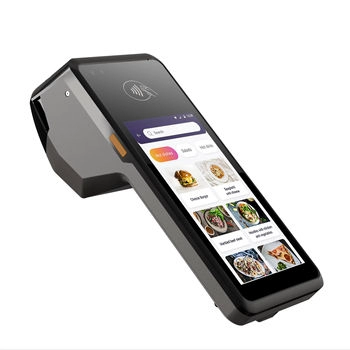
Faster Time-to-Market with a One-Stop Delivery Model
By combining PCB design, hardware validation, and PCBA preparation in one workflow, the POS project moved efficiently from design to ready-to-ship hardware. This reduced coordination costs, shortened development cycles, and allowed the client to launch the product without delays caused by handoffs between multiple vendors.
Application Scenarios|Designed for Real Business Use
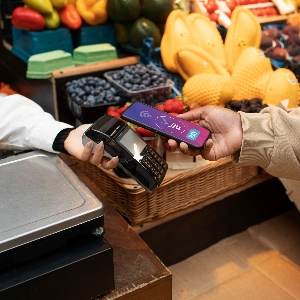
Retail POS Systems
- Fast checkout and inventory lookup
- Seamless connection with scanners, printers, and cash drawers
- Real-time sales data synchronization via Wi-Fi 6
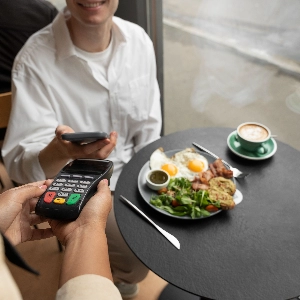
Restaurant & Café Ordering
- Mobile ordering and table-side payment
- Support for kitchen printer integration
- Stable wireless performance in busy dining environments
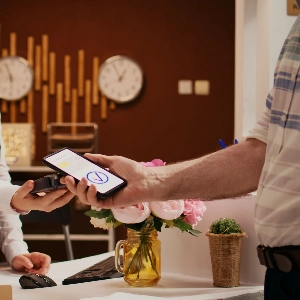
Hotel Front Desk Systems
- Check-in deposits and billing
- Integration with PMS software
- Secure NFC and card-based payment support
How We Control Quality in Touch Screen POS Terminal PCB Projects
Design Rule Control for POS-Specific Interfaces
Before layout, POS-focused design rules were defined for display, touch, USB, Ethernet, and power circuits.
This prevented common issues such as unstable touch signals, USB communication errors, and Ethernet noise sensitivity.
Critical Net Inspection & Power Integrity Checks
Key nets including CPU core power, DDR, display signals, USB, and wireless supply rails were individually reviewed.
Voltage drop, trace width, return paths, and decoupling placement were verified to ensure stable operation under full system load.
Prototype Bring-Up & Functional Validation
First samples were powered, debugged, and tested with real POS peripherals such as scanners, printers, and cash drawers.
Only after stable boot, continuous operation, and interface verification did the design move forward for production preparation.

Looking to Build or Upgrade a POS Hardware Platform?
One-stop PCB design & PCBA manufacturing for industrial devices